9.11. 多電子励起の除去
 XAS は通常は一電子過程によるものと考えられています.光子が入り,光電子が出て行く.実際のところ,多体現象が起こる可能性はあり,場合によっては XAS データの解釈において考慮されなければなりません.そういったものの1つにいわゆる “shake-off” 効果,すなわち光電子がよりエネルギー準位の高い位置にある電子を励起するのに十分な運動エネルギーを持っている場合があります.例えば,U LIII edge の 415 eV 高エネルギー側の光電子は,N6 あるいは N7 の遷移を励起させることができます.
The cross-section of this secondary edge can be quite small. In the example of the LIIIN6,7 transition, the secondary cross section is about 3 orders of magnitude smaller than the primary LIII edge. If, in this example, you have very good data with measurable EXAFS beyond about 10.5 Å-1, the multi-electron excitation will not be small compared to the LIII EXAFS. Other multi-electron excitations have even larger cross-sections compared to their primary excitations. For an excellent discussion of multi-electron excitations see Iztok Arcon's Multielectron photo excitations page.
Another phenomenon which is somewhat similar in its effect on your data is the presence of a small impurity of the Z+1 element, leading to a small edge step well above the measured edge. In some cases this small edge step might be hard to see in your μ(E) data, but are clearly visible as a step in the χ(k) which Fourier transforms into a low-R contribution in the χ(R) spectrum.
ATHENA は多電子励起あるいは微量の不純物による段差をデータから取り除くための2つの比較的簡単なアルゴリズムを提供しています.One models the multi-electron excitation as a reflection of the data translated to the position in energy of the excitation. もう1つは特定のエネルギーにアークタンジェント関数を引くその結果を適切に評価するための十分な知識が必要です.
ご用心
The algorithm described here requires considerable user input and sufficient knowledge to reasonably process the data. In no case will the result be perfect. Use this tool carefully!
それでは,やってみましょう.
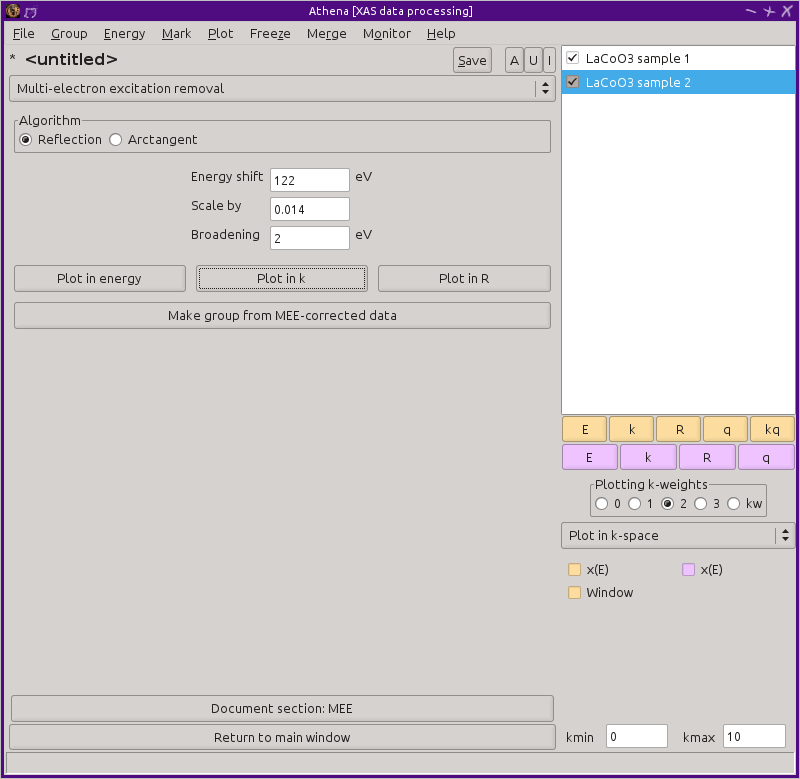
図 9.32 多電子励起除去ツール
残念なことに,ATHENA にはこれらの微妙なパラメータを推定するための現実的な方法はありません.よって,全てはユーザの適切な設定にゆだねられています
以下は吸収端の 120 eV 上に [3p4d]5d の励起過程を示す LaCoO3 のデータです.
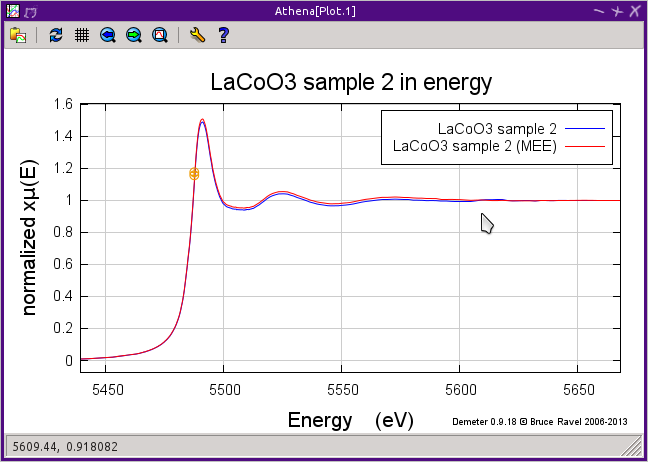
図 9.33 The results of removing the [3p4d]5d multi-electron excitation in
La LIII-edge data, which occurs at about 120 volts above
the edge. This excitation is seen near the cursor in the energy
plot. This plot is made by  clicking
Plot in energy.
clicking
Plot in energy.
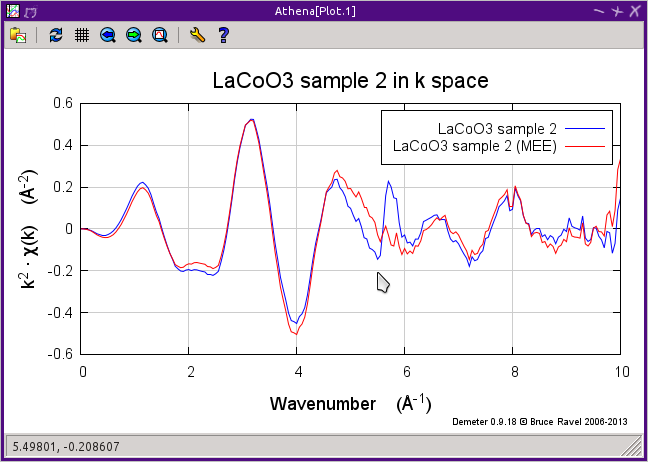
図 9.34 Its effect is much more pronounced in the χ(k) data. This
plot is made by clicking Plot in
k.
多電子励起過程のより詳しい情報については,以下を参照してください.
- A. Kodre, I. Arcon, M. Hribar, M. Stuhec, F. Villain, and P. Parent. Double photoexcitation [2(s,p)4(p,d)] in the Xe-isoelectronic series Cs+, Ba2+, La3+. J. Phys. IV, 4(C9):C9–397 – C9–400, 1994. doi:10.1051/jp4:1994966.
上のスクリーンショットに示されているパラメータを使うと,図中の赤線で示されたところで除去が行われます.シフトはまず,XANES のホワイトラインと 5.7 Å-1 に見られる特徴的な箇所の間で推定されます.その値は,121.04 eV とわかります.少し調べた後,私は 122 eV に設定しました.
この例の場合,反映されたデータの強度は 0.014 にスケールされました.この値は吸収端の半分の値です.つまり,その値は規格化されたデータに依存します.もし,この値が負の値になるようであれば,実際には,0 に設定されます.(つまり,除去は行われません)
最終的に,XANES のデータは 2, 3 eV だけブロード化されます.もし,この値を 0 あるいは負の数に設定すると,0.01 eV が値として,使われます.
一度,多電子励起除去をうまくできる一連のパラメータを見つけられれば,励起の効果が除去されたデータはグループリストのグループとして保存されます.
他のすばらしい χ(E) データへの小さな多電子励起の影響に関するよいレファレンスとしては,以下があります.
- Christoph Hennig. Evidence for double-electron excitations in the L3-edge x-ray absorption spectra of actinides. Phys. Rev. B, 75:035120, Jan 2007. doi:10.1103/PhysRevB.75.035120.
DEMETER is copyright © 2009-2016 Bruce Ravel – This document is copyright © 2016 Bruce Ravel
This document is licensed under The Creative Commons Attribution-ShareAlike License.
If DEMETER and this document are useful to you, please consider supporting The Creative Commons.